
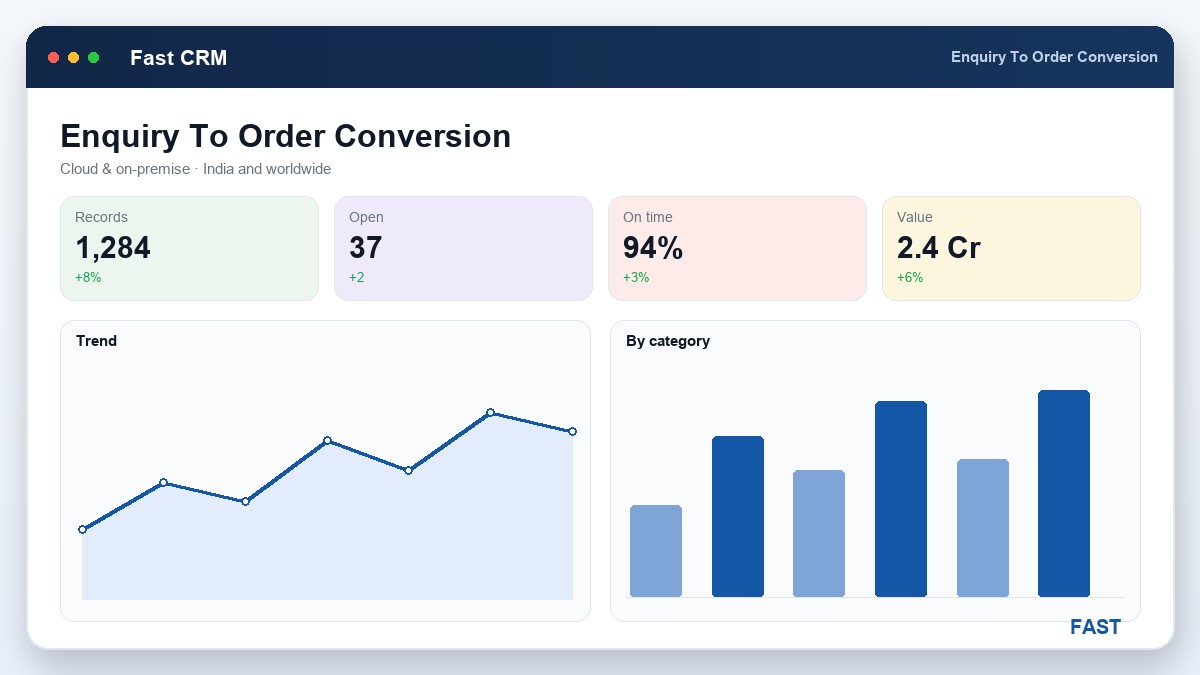
Two manufacturers receive the same hundred enquiries. One converts fifteen of them into orders; the other converts twenty-eight. Neither has a better product, a lower price or a bigger sales team. The difference is entirely in how they run the journey between the enquiry landing and the order being confirmed — whether each enquiry is captured with its source, costed properly, quoted on real cost, and chased to a decision instead of left to fade. That journey, and the specific habits that move the number, is what this guide is about.
This is a practical companion to our overview of the category, what is manufacturing CRM software. There we defined the pipeline; here we work it — stage by stage — and show where win rate is actually won and lost. Throughout, the reference points are the real workflows in Fast CRM Software, the sales front end of the Fast Suite, used by manufacturers of every kind, cloud or on-premise, across India and worldwide.
1. What conversion really is — and why it is the truest number you have
Enquiry-to-order conversion — the EQ-to-OA ratio — is the share of enquiries you receive that end up as confirmed orders. It sounds simple, and that is exactly its value: it is a single number that quietly grades your entire commercial process. A low conversion rate is never one problem. It is the sum of enquiries logged badly, estimates that took too long, quotes priced on a guess, and follow-up that never happened.
Most manufacturers cannot state their conversion rate with confidence, for one reason: they never captured the denominator. If enquiries live in an inbox and only the won ones ever became "orders" in a system, you literally cannot know what share converted — the enquiries you lost left no trace. The first discipline of improving conversion is therefore boringly practical: record every enquiry as a document, won or lost, so the rate can be measured at all.
- Every enquiry is captured — as a numbered document (EQ) with the customer, the items, the quantity and the source, not a subject line someone may or may not act on
- Every outcome is recorded — an enquiry that will not be pursued is regretted and kept in the analytics, so your denominator stays honest
- Every stage is owned — feasibility, estimation, quotation and follow-up each have an owner and a status, so a stalled enquiry is visible instead of silent
You cannot improve a conversion rate you cannot measure, and you cannot measure it unless every enquiry — including the ones you lose — is recorded. Capture first; optimise second.
2. The conversion journey, stage by stage
A make-to-order enquiry does not jump from received to won. It passes through a defined sequence, and conversion leaks at every join. Naming the stages is the first step to plugging them.
| Stage | What has to happen | Where conversion leaks |
|---|---|---|
| Enquiry received | Logged with items, quantity and source | Enquiry sits in an inbox, never recorded |
| Feasibility | Quick doable / not-doable decision | Weeks pass before anyone says yes or no |
| Estimation | Costed against a BOM / Bill of Resources | Estimate is slow, so the customer buys elsewhere |
| Quotation | Approved and sent on real cost | Priced on a guess; margin too thin or too fat |
| Follow-up | Chased to a decision on a schedule | Quote sent and then forgotten |
| Order won | Quote converts to a confirmed order | Win never captured; re-keyed and mangled |
Read that right-hand column again: none of the leaks are about the product or even the price. They are about process — speed, discipline and memory. Which is good news, because process is the thing you can actually change without cutting margin. The rest of this guide takes the leaks in order.
3. Capture the enquiry source — the habit that pays for itself
When an enquiry arrives, one field is worth more than all the others for improving conversion over time: where it came from. Referral, repeat customer, website form, a campaign, an exhibition, an agent — the source. It takes five seconds to record and it is the foundation of every meaningful conversion analysis you will ever run.
Here is why it matters concretely. Suppose exhibition enquiries feel exciting — lots of cards, lots of energy — but quietly convert at a fraction of the rate of referral enquiries. Without the source on every enquiry, you will keep spending on exhibitions because they feel productive. With it, you can see that a rupee spent chasing referrals converts several times better, and redirect effort accordingly. The source turns a gut feeling into a decision.
- Record the source on every enquiry — as a reference type, so it can be reported on, not buried in a notes field
- Tie web enquiries in automatically — a website enquiry should land as an EQ with its source pre-set, no re-typing
- Keep the party's reference too — who introduced this customer, and which contact owns the relationship
In practice this all sits inside lead & enquiry capture: leads captured on desk or mobile, enquiries recorded with items and — crucially — their source, ready to be sliced later by the conversion reports.
4. Estimation discipline — feasibility first, then a real cost
The second leak is speed and rigour at the estimate. Two failures are common and opposite. Some firms are too slow — the enquiry sits for weeks in "under estimation" while a busy engineer finds time — and the customer, who asked three suppliers, has already placed the order with whoever answered first. Others are too fast in the wrong way — they skip the costing entirely and quote a round number from memory, then discover at the order stage that the margin is gone.
The discipline that fixes both is a two-step gate: a quick feasibility decision, then a proper estimation against a structure.
- Feasibility first. Before any costing effort, decide fast whether the enquiry is doable. A no here — regretted, and kept in the analytics — saves the estimating time for enquiries you can actually win.
- Estimate against a BOM or Bill of Resources. Build the cost from the material and the resources — machines, labour, tooling, operations — the item actually consumes, so the number has a basis you can defend and reuse.
- Make the estimate reusable. A repeat or similar enquiry should start from the last estimate, not a blank sheet, so speed and rigour stop being a trade-off.
This is exactly what feasibility & estimation does — an enquiry moves through a feasibility status and is costed against a BOM/BOR before it can be quoted, so the price that goes out is grounded in real cost rather than optimism.
In a competitive enquiry, the supplier who quotes first is often shortlisted before the others have finished estimating. A reusable, structured estimate is not just about margin accuracy — it is about being the quote on the table when the customer decides.
5. Quote on real cost — and make the quotation easy to say yes to
A quotation does two jobs at once: it protects your margin and it earns the customer's yes. Quoting on real cost — the estimate you just built — handles the first. The second is about how the quote is constructed and presented.
- Terms that are configured, not improvised. Delivery, payment, validity, taxes and packing should come from a template of quotation parameters, so every quote is complete and consistent rather than depending on which salesperson wrote it.
- Approved before it goes out. A release gate on the quotation means a discount or a term outside policy is caught before the customer sees it, not renegotiated after.
- Professional and prompt. A clean, printed quotation emailed the same day beats a better price that arrives a week late.
Crucially, the quotation should reference the enquiry it came from, so the whole chain stays linked. When the customer later says yes, you are not re-typing anything — the quote becomes the order. The detail of building, revising and approving quotes is covered in our quotation management guide and on the quotation management feature page.
6. Structured follow-up — dashboards, tasks and call planning
This is where most win rate is quietly lost. A quotation is sent, the salesperson turns to the next fire, and the quote is never actively chased. The customer, who was genuinely interested, drifts — and eventually buys from the supplier who stayed in touch. The fix is not "try harder to remember." It is structure.
- A stage-wise follow-up dashboard. Every sent quotation sits on a dashboard with an owner and a next-action date. A quote not touched in a week surfaces itself, ageing visibly, instead of sinking out of mind.
- Tasks and a shared board. "Call Kumar about the pump quote on Thursday" becomes an allocated task with a due date on a kanban board the whole team can see — so follow-up survives a salesperson's day off.
- Call planning. Today's calls and pending calls are listed for each caller, with click-to-dial, so a morning of follow-up is a worked list, not a scramble through notes.
These are three different tools for one job — never letting an interested customer go untouched. They live across follow-up & Customer 360 and tasks, calls & activities, with every call logged automatically via cloud telephony and click-to-dial. Our dedicated sales follow-up guide goes deep on running this well over long cycles.
7. Measure EQ-vs-OA conversion — by source and by salesperson
Everything so far is habit. This is the feedback loop that tells you whether the habits are working and where to aim next. Because every enquiry carries its source and its owner, and every won quote becomes a linked order, conversion can be measured two ways that change behaviour:
- By source. Which channels actually convert to orders, not just generate enquiries — so marketing spend follows the money.
- By salesperson. Who turns enquiries into orders, and whose pipeline stalls — so coaching is aimed at the real gap, be it estimating speed or follow-up.
| Sample conversion dashboard — by source (illustrative) | Enquiries | Orders | Conv. |
|---|---|---|---|
| Referral / existing customer | 40 | 18 | 45% |
| Website enquiry | 35 | 9 | 26% |
| Exhibition | 50 | 6 | 12% |
| Campaign / cold | 25 | 2 | 8% |
The figures above are an illustrative mock-up of the kind of view a conversion dashboard produces — not a claim about any real deployment. The pattern it exposes, though, is the whole point: referral converts nearly four times better than exhibition, so effort should follow.
In Fast CRM this is the MIS layer over the pipeline — enquiry-vs-order conversion, reference-wise and salesperson-wise, plus quotation status and pipeline value. Add Dhruv AI and you can ask the same questions in plain English and get clustered themes out of your enquiry and lost-reason remarks.
8. Don't let quotes go cold — the ageing discipline
It is worth isolating the single highest-yield habit, because it is the one most often skipped: working the ageing. A quotation has a natural window in which the customer is deciding. Miss it and the quote is not lost so much as abandoned. An ageing view — quotes sorted by how long since the last contact — turns that window into a queue you can work.
- Sort open quotes by ageing. The oldest untouched quote is the one most at risk; work the top of the list first.
- Set a next-action date on every quote. Not "follow up sometime" — a date, so the dashboard can tell you what is due today.
- Regret honestly and promptly. A quote that is genuinely dead should be closed as regretted, so your live pipeline reflects reality and your conversion denominator stays true.
9. How Fast CRM Software runs the conversion engine
Fast CRM Software, built in Pune by Improsys under the Fast Technology brand, implements every stage above as a real, linked workflow — cloud or on-premise, for manufacturers of every kind across India and worldwide:
| Conversion lever | How Fast CRM Software does it |
|---|---|
| Capture the source | Every enquiry (EQ) is logged with items, quantity and a reference source; website enquiries land automatically with their source set. See lead & enquiry capture. |
| Estimate with discipline | A feasibility decision gates the costing, then the enquiry is estimated against a BOM/BOR so the price is grounded and reusable. See feasibility & estimation. |
| Quote on real cost | Quotations carry configurable terms, are approved before sending, and reference their enquiry so the chain stays linked. See quotation management. |
| Follow up in structure | Stage-wise dashboards with next-action dates and ageing, allocated tasks on a shared board, and call planning with click-to-dial keep every quote alive. See follow-up & Customer 360. |
| Convert cleanly | A won quotation converts to an Order Acceptance (OA) with nothing re-keyed, then hands off to production and billing. See order acceptance. |
| Measure and coach | Enquiry-vs-order conversion by source and salesperson, quotation status and pipeline value — with Dhruv AI for plain-English questions and remark clustering. |
Turn more of the enquiries you already receive into orders.
Fast CRM captures every enquiry with its source, estimates it against a real BOM, quotes on real cost, chases it on a dashboard that ages, and converts the win into an order that production and billing consume — all on one platform and one customer record. Then it shows you, by source and by salesperson, exactly where the pipeline leaks.
10. Frequently asked questions
Find the leak in your own pipeline
A 30-minute demo on your enquiries — capture, estimate, quote, follow-up and the conversion dashboards that show where win rate is lost.