Somewhere in your sales team's inbox right now there is an enquiry nobody is fully accountable for. A customer sent a drawing three weeks ago; someone replied that they would "check feasibility and revert." The estimate is half-done in a spreadsheet, the quotation was sent — or was it the revised one? — and whether the customer is still interested lives in one salesperson's head. When the director asks how many open enquiries are worth chasing this month, the honest answer is "let me go and ask around." That gap — between the enquiries you received and the orders you actually converted — is the problem a manufacturing CRM exists to close.
This guide is written for the person evaluating the software category — a business owner, sales head or director of a make-to-order manufacturer deciding what to buy and what to ask vendors. It covers what a manufacturing CRM actually does step by step, the capabilities that separate a real sales-pipeline system from a contact list with a login screen, and how Fast CRM Software implements each one. If you want to learn the underlying discipline first — what CRM is as a practice, independent of any tool — start with our pillar guide, What is CRM software?, and come back here when you are ready to compare products.
The Learn Hub pillar guide teaches CRM as a practice — the pipeline, the vocabulary, why customer history matters. This article assumes you know why sales control matters and focuses on the buying decision for a manufacturer: what a document-driven CRM does, where products differ, and what to check before you sign.
1. What is manufacturing CRM software?
Manufacturing CRM software — sometimes called B2B CRM, sales-pipeline or quote-to-cash software — gives an engineering or make-to-order business a single, structured way to capture a lead or enquiry, assess feasibility, cost an estimate, raise and revise a quotation, chase it to a decision, and convert the won quote into a confirmed order. It sits at the front of the quote-to-cash cycle: it originates the customer demand that production later builds and accounts later invoice.
The starting point is always the same: a real customer request. A customer sends an enquiry — often with a drawing, a specification and a quantity. From there the CRM drives a defined path: Lead → Enquiry → Feasibility → Estimation → Quotation → Order Acceptance. Once an enquiry is captured, every downstream step becomes a numbered, owned, dated document rather than a note in an inbox or a cell in a spreadsheet.
The key word is document-driven. Plenty of tools can store a contact and a "deal." The difference a real manufacturing CRM makes is that nothing about the commercial detail is optional or memory-dependent:
- Every request is an enquiry document — with item lines, quantity, drawing references, the customer and the source it came from, not a subject line in someone's mailbox
- Every price is a costed estimate — the enquiry is assessed for feasibility and costed against a BOM or Bill of Resources before a number goes out, so you quote on real cost rather than a guess
- Every quote is a versioned document — a quotation carries terms, is revised with a full history, and is approved before it reaches the customer
- Every won quote becomes an order — the quotation converts into an Order Acceptance that hands off to production and billing, carrying its item lines forward untouched
- Every open item gets chased — enquiries and quotations sit on follow-up dashboards with a next-action date, so nothing goes cold because someone forgot
For manufacturers working to a quality system such as ISO 9001 or IATF 16949, this is not just good housekeeping — it is the working machinery behind order traceability: which enquiry led to which quotation, who approved it, what was agreed, and which order the factory is now building. Our lead & enquiry capture and quotation management pages cover the document chain in detail.
2. Why a generic contact CRM fails for make-to-order
Most manufacturers do not start with no system. They start with a shared inbox, an estimation spreadsheet, a quotation template in Word, and a "sales tracker" — either a spreadsheet or a generic contact CRM designed for salespeople selling a fixed product. It feels adequate until volume, staff turnover or a customer audit exposes it. The failure modes are consistent enough to list:
- No commercial document. A generic CRM records a "deal" worth an amount and a probability, but the enquiry's item lines, drawing and quantity live in an attachment. The thing you actually negotiate — the priced line — is not in the CRM at all.
- No estimation link. The price a salesperson types into a deal has no connection to a costing. When the margin turns out to be wrong, there is no trail back to the BOM or Bill of Resources it should have been built on.
- Quotes that drift. Revision three goes out, but the CRM still shows revision one's amount. Which version did the customer actually accept? Nobody is sure, and the order gets built to the wrong terms.
- Stages that are just words. "Qualified," "Proposal," "Negotiation" are labels a salesperson drags a card between. They do not correspond to a real feasibility check, a real approval, or a real order — so the pipeline looks healthy while nothing is actually progressing.
- A broken handoff. When a deal is finally "won," someone re-keys the whole thing into the ERP or a production sheet — re-typing items, quantities and rates, and introducing errors at exactly the moment accuracy matters most.
- No conversion truth. A generic CRM can tell you deals won and lost. It cannot tell you which enquiry source converts, or which salesperson turns enquiries into orders, because it never captured the enquiry as a first-class object.
None of this fails loudly. That is what makes it dangerous: a contact CRM never sends you a report saying the quote the customer accepted was a superseded revision, the margin was estimated on nothing, and half your enquiries from the best-converting source were never followed up.
3. What the software does — the enquiry-to-order lifecycle
Whatever the vendor, a make-to-order sale follows broadly the same sequence. What a manufacturing CRM does is make each step explicit, owned and recorded — so the process runs the same way whether the team is handling five enquiries a week or five hundred.
| # | Step | What the software does |
|---|---|---|
1 |
Lead capture | A raw prospect — from a referral, a campaign, a website form or an exhibition — is captured as a lead, on the desk or on a mobile-friendly field-entry screen. Qualified leads become enquiries. |
2 |
Enquiry received | The customer request is recorded as an enquiry document (code EQ, status 31 — Enquiry Received) with item lines, quantity, drawing and — crucially — its source, so you can later measure which channels convert. |
3 |
Feasibility | Sales and engineering assess whether the enquiry is doable (status 32 — Under Feasibility). Not viable? It is regretted (status 36) and kept in the analytics, not silently dropped. |
4 |
Estimation | The item is costed against a BOM or Bill of Resources (status 33 — Under Estimation) so a price can be derived from real material and resource cost, not a round-number guess. |
5 |
Techno-commercial review | The estimate passes a review of technical scope and commercial terms before it can be quoted — margin, delivery, payment and validity are settled, not left to the salesperson's discretion. |
6 |
Quotation | A quotation (code QT) is raised referencing the enquiry, carrying configurable terms; it is approved, then sent (status 34 — Quotation Sent). Revisions are versioned with full history. |
7 |
Follow-up | The sent quotation sits on a follow-up dashboard with a next-action date. Sales chase it — logging calls, notes and outcomes — until the customer decides, so it never goes quietly cold. |
8 |
Order won | On win, the quotation converts to an Order Acceptance (code OA, status 35 — Order Received). The enquiry-to-quote-to-order chain is now a single linked record, nothing re-typed. |
9 |
Order handoff | The order is checked, released and completed, then handed off — to Fast Production to plan and build, and to Fast Billing to dispatch and invoice against the same order. |
10 |
Post-sale & MIS | Payment is chased on a payment dashboard, feedback is captured, and conversion MIS rolls up — enquiry-vs-order by source and by salesperson — for the management review. |
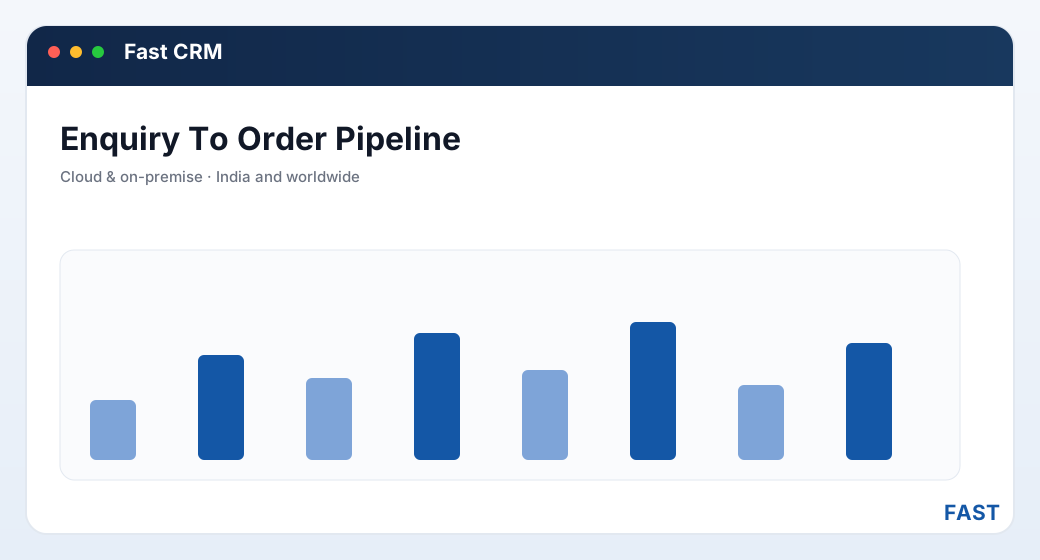
The pipeline is one linked chain, not five disconnected steps — the enquiry references the lead, the quotation references the enquiry, and the order references the quotation, so the whole sale is reconstructable end to end.
4. Core capabilities checklist
Feature lists blur together quickly. These are the eight capabilities that actually determine whether a product can run a make-to-order sales team — use them as your evaluation checklist.
- Lead entry on desk and mobile field capture
- Enquiry with item lines, drawing and quantity
- Enquiry source / reference tracked
- Feasibility check before a price is promised
- Costed against a BOM / Bill of Resources
- Techno-commercial review before quoting
- Raise, revise and approve quotations
- Configurable terms and parameters
- Version history and quotation comparison
- Won quote converts to a confirmed order
- Check, release and complete workflow
- Sample and tooling order sub-types
- Stage-wise dashboards for lead, enquiry, quote, order
- Next-action date and ageing on every open item
- Notes and call history logged against the document
- One party record — contacts, addresses, references
- Agreed item rates and discounts
- Full enquiry, quote, order and payment history
- Task allocation with priority and due date
- Drag-and-drop kanban board and calendar
- Call planning, click-to-dial and visit plans
- Enquiry-vs-order conversion measured by source
- Salesperson-wise pipeline and win-rate
- Quotation status and value reporting
Alongside these eight, check the document discipline: does the system understand that the enquiry, quotation and order are the same commercial line carried forward — the quote referencing the enquiry, the order referencing the quote — so nothing is re-keyed on conversion? A product that treats each stage as an unlinked record will lose the chain the first time a quotation is revised, and no amount of dashboards will fix a pipeline whose documents do not join up. Telephony matters too: with cloud IVR and click-to-dial every call is logged against the customer automatically.
5. Manufacturing CRM vs generic CRM — and how it hands off to production and billing
Buyers often discover mid-evaluation that "sales CRM" and "manufacturing CRM" are answering two different questions. They are related but not the same, and for a make-to-order business the best arrangement runs the CRM on the same platform as production and billing rather than bolting a contact tool onto a separate factory system.
| Aspect | Manufacturing CRM | Generic contact CRM |
|---|---|---|
| Core object | The enquiry, quotation and order — real documents | The contact and the "deal" — a name and an amount |
| Pricing | Costed against a BOM / Bill of Resources | A number typed into a deal field |
| Quotation | Versioned, approved, compared, printed | An attachment, tracked loosely if at all |
| Stages | Defined statuses with owners and gates | Labels a salesperson drags a card between |
| On win | Converts to an order that production builds | Marked "won"; the order is re-keyed elsewhere |
| Conversion truth | Enquiry-vs-order by source and salesperson | Deals won/lost, but not by enquiry source |
The point is not that a manufacturing CRM replaces your other systems — it is that the pipeline must share the same data as the factory and the accounts. A manufacturing CRM is the front end of quote-to-cash and a feeder of production and billing:
- Production builds what the CRM sells. A won Order Acceptance feeds work-order generation, so the factory plans and makes the exact order the sales team closed. Explore order acceptance.
- Billing / ERP invoices what production ships. Dispatch and invoicing run against the same order, so what was quoted, ordered, made and billed are one chain. See Fast ERP & Billing.
- Follow-up & Customer 360 holds the relationship. Every enquiry, quote, order, call and payment sits on one customer record. See follow-up & Customer 360.
In Fast CRM these are not integrations in the brittle sense — they are the same platform and the same document engine, so an enquiry, a quotation and an order all interoperate natively with production planning and invoicing on one customer record. Nothing is re-keyed at a boundary.
6. Who needs a manufacturing CRM?
Not every business needs a document-driven CRM on day one. These are the situations where a shared inbox and a generic deal tracker reliably stop being enough — and they span manufacturers of every kind, cloud or on-premise, across India and worldwide:
| Business | Why a document-driven CRM becomes necessary |
|---|---|
| Make-to-order manufacturers & automotive | Every sale starts as a technical enquiry, needs an estimate against a BOM, and closes only after a negotiated quotation — with parts, tooling, NPD and sample work all tracked. See manufacturing CRM software. |
| Job shops & engineering firms | Each enquiry is one-off and must be costed against a per-order BOM/BOR before a price can be quoted, so estimation discipline is the whole game. See job shop CRM software. |
| Capital-equipment makers | Long, multi-touch sales cycles run over months and must be chased through stage-wise follow-up dashboards so nothing goes cold. See capital equipment CRM software. |
| Sales offices of a group | A branch that captures leads, runs telephony and holds customer history but hands orders to a central ERP needs the pipeline without the factory. See sales office CRM software. |
The practical trigger is usually one of three events: an order built to the wrong quotation revision that nobody could reconcile; a customer or ISO audit finding on how quotations are approved and orders traced; or a growth stage where the number of concurrent enquiries outruns the memory of the one sales manager who used to hold it all together.
7. Cloud vs on-premise, and how to evaluate a manufacturing CRM
Two questions decide most of the shortlist: where it runs, and whether it fits your real sales flow. On deployment, the honest answer is that it should be your choice, not the vendor's constraint — Fast CRM runs cloud and on-premise, so a distributed sales office can start in the cloud while a manufacturer with its own IT and data-residency policy hosts it on its own servers, on the same product. Beyond that, most demos look good; the differences show up in the specifics, so evaluate against your own pipeline rather than the vendor's script.
- Do your enquiries need an estimate against a BOM or Bill of Resources before you can quote?
- How many quotation revisions does a typical deal go through, and who approves them?
- Where does a won quote turn into an order, and who re-keys it today?
- Ask the vendor to walk one enquiry from capture through estimate, quote and won order
- Check the conversion specifically — does the quotation's items carry into the order untouched?
- Check that every enquiry, quote and order leaves a linked trail you could show an auditor
- Is the price built from a real costing, or just a number in a field?
- Are quotation revisions versioned with history, and can you compare them?
- Can quotation terms be configured per customer or per deal, or are they hard-coded?
- Does every open enquiry and quote carry a next-action date and show its ageing?
- Are calls logged automatically against the customer, or typed up after the fact?
- Can tasks be allocated to the team and tracked on a shared board?
- Enquiry-vs-order conversion sliced by source and by salesperson
- Open pipeline by stage, value and ageing at a glance
- Quotation status and win-rate for trend analysis
- Does the same customer master serve sales, production and billing, or will you maintain several?
- Can a won order be handed to the factory without re-entry?
- Can it run standalone for a sales office and grow into full ERP later, cloud or on-premise?
8. How Fast CRM Software implements each capability
Fast CRM Software is the sales-pipeline product of the Fast Suite, built in Pune by Improsys under the Fast Technology brand, and it serves manufacturers of every kind across India and worldwide, cloud or on-premise. It runs each capability above with real, named workflows — the same ones you would see in a demo:
| Capability | How Fast CRM Software does it |
|---|---|
| Lead & enquiry capture | Leads are captured on the desk or a mobile field-entry screen; qualified leads become enquiry documents (EQ) with item lines, drawings and quantity, and every enquiry records its source so you can measure which channels convert. See lead & enquiry capture. |
| Feasibility & estimation | An enquiry is assessed for feasibility, then costed against a BOM or Bill of Resources so the price is built from real material and resource cost, with a techno-commercial review before it can be quoted. See feasibility & estimation. |
| Quotation management | Quotations (QT) reference their enquiry, carry configurable terms, are approved before they go out, and are revised with full version history and side-by-side comparison. See quotation management. |
| Order acceptance | A won quotation converts to an Order Acceptance (OA) that is checked, released and completed, then handed off to production and billing — sample and tooling orders tracked as their own sub-types. See order acceptance. |
| Follow-up & Customer 360 | Stage-wise dashboards chase open leads, enquiries, quotations and orders with next-action dates and ageing; every call, note, rate and payment sits on one Customer 360 party record. See follow-up & Customer 360. |
| Tasks, calls & activities | Tasks are allocated with priority and due date, moved across a drag-and-drop kanban board and shown on a team calendar; call planning, click-to-dial and field-visit plans keep the team on the next action. See tasks, calls & activities. |
| Analytics | Enquiry-vs-order conversion by source and salesperson, quotation status and pipeline value report the funnel live; and Dhruv AI adds a sales role dashboard, plain-English questions over your pipeline data in a read-only sandbox, and clustering of enquiry and feedback remarks into labelled recurring themes. |
Start with the pipeline. Grow into production, billing and full ERP.
Fast CRM runs the front end of quote-to-cash — lead and enquiry capture, feasibility and estimation, quotation, order acceptance, follow-up and Customer 360. Because it shares one platform and one document engine with the rest of the Fast Suite, a won order generated in Fast CRM feeds work-order generation in Fast Production and dispatch and invoicing in Fast Billing — on the same customer record, with nothing re-entered.
9. Frequently asked questions
See the whole pipeline on your own enquiries
A 30-minute demo — your enquiry, your estimate, your quotation and your won order walked live on screen. No generic slideshow.